Introduction
Following Edward’s ski touring experience in March 2024, where he was almost airlifted in Chamonix due to a combination of altitude sickness and exhaustion, Elec Ski began questioning how accessible ski touring really is.
Extensive market research later in 2024 confirmed what that experience suggested. Traditional ski touring is physically demanding, technically challenging, and inaccessible for many skiers due to fitness requirements, altitude exposure, time constraints, and safety concerns. Inspired by the path already taken by the mountain biking industry with e bikes, Elec Ski began developing an electric assisted ski touring system designed to reduce the physical barrier of uphill travel without removing the core experience of Ski touring in the mountains.
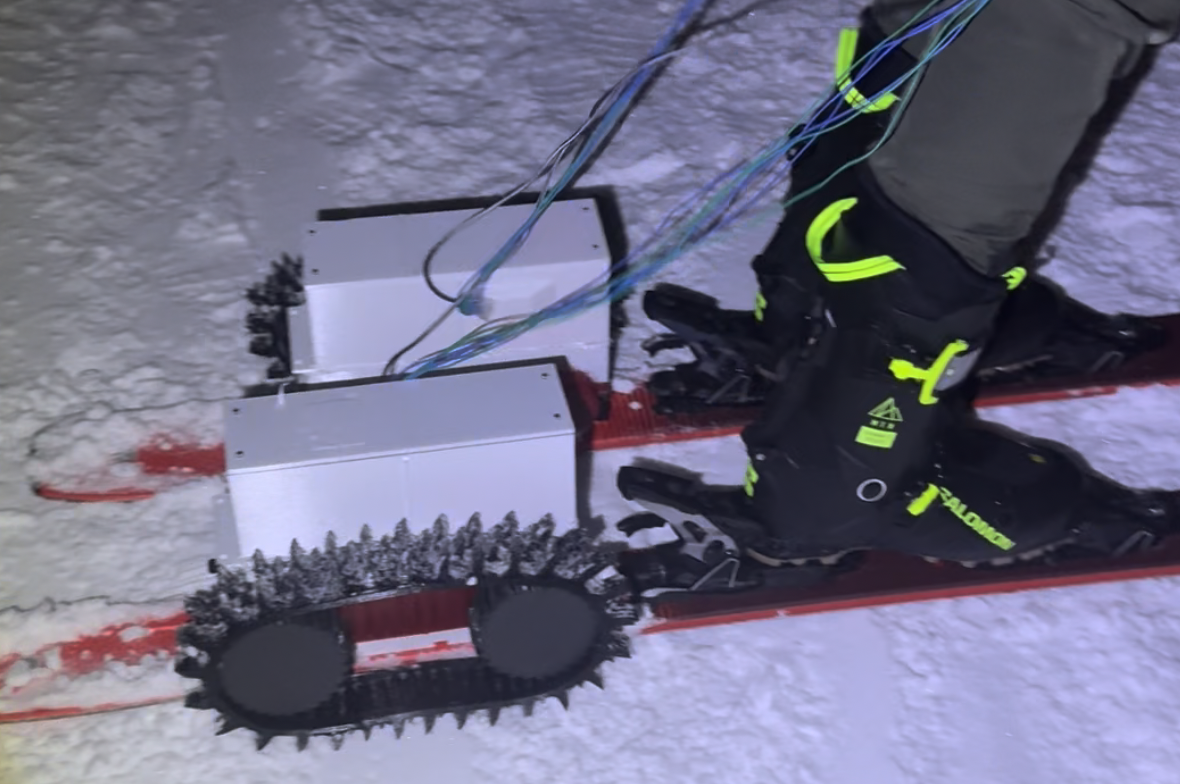
This work led to the creation of Elec Ski Prototype V1, a proof of concept electric ski assist system built using microcontroller development kits, a custom battery system, and wired hand held remotes. One principle became clear very early. The system had to be fully detachable. Rather than reinventing the ski, Elec Ski focused on developing a modular electric assist unit that could attach to existing skis. This approach resulted in the patent pending slot in mounting system, allowing skiers to slide the unit on and off their own skis as required.
Testing in Tignes, France
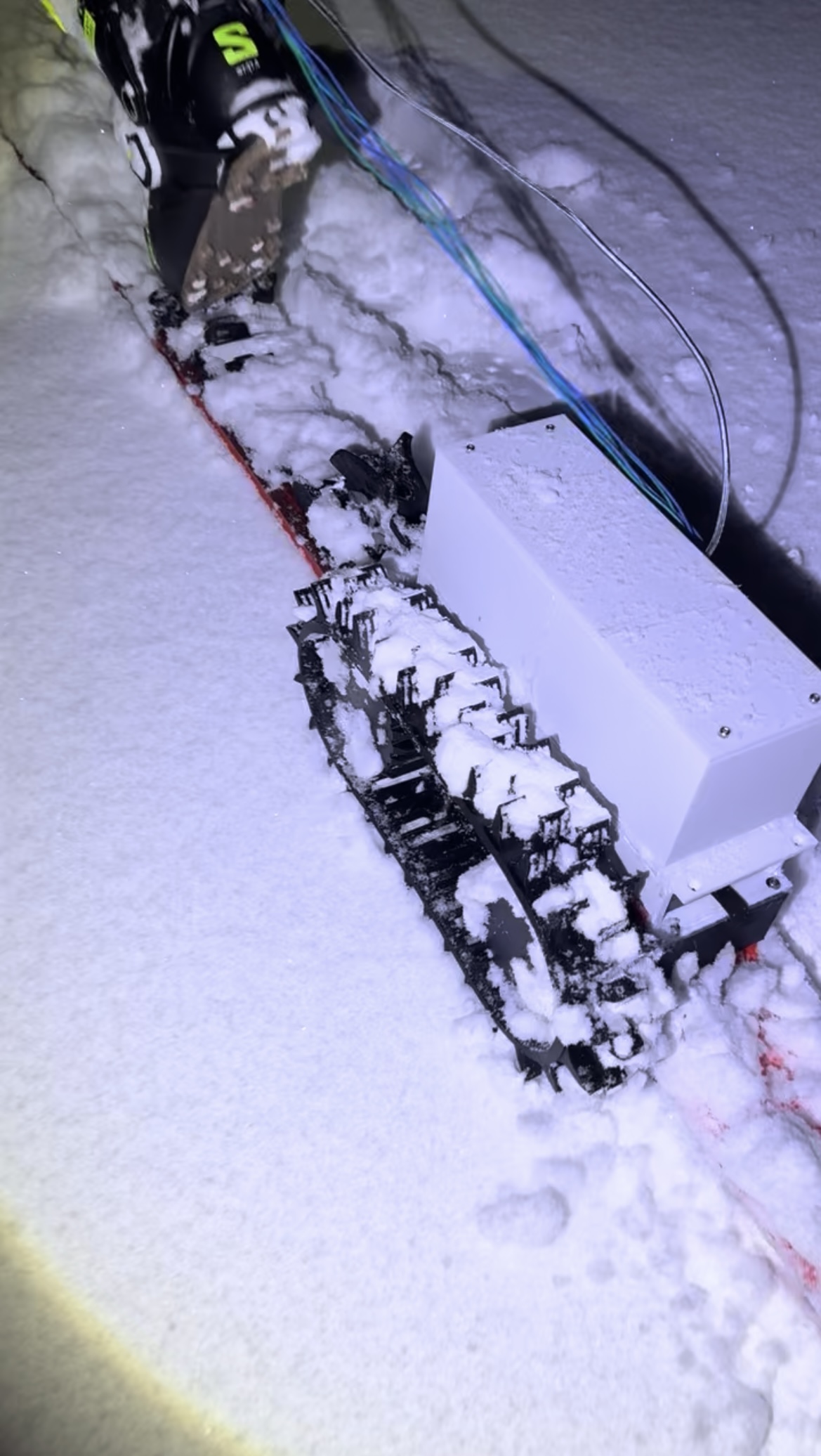
With the V1 system assembled, real world testing became essential. Tignes provided the ideal environment to push the prototype beyond the workshop and into genuine alpine conditions. The testing focused on traction, drivetrain reliability, power delivery, and overall usability while ski touring. The video below captures this early V1 testing phase and offers a raw look at what worked, what did not, and what was learned.
Elec Ski Prototype V1 was very much a proof of concept electric ski assist system. Before any further development could take place, the system needed to be tested in real alpine conditions to understand its limitations and validate the core idea. The V1 system tested in Tignes featured:
The primary goal of this testing phase was not refinement or performance optimisation. It was to observe how an early electric assisted ski touring system behaved on snow, under load, and in real terrain.Unsurprisingly, the testing quickly exposed a number of challenges:
In real world use, the system was difficult to operate and far from refined.
However, this was expected at such an early stage of development.
Why the V1 Testing Mattered
Despite its shortcomings, the Tignes testing phase proved something critical...
Electric assisted ski touring is possible.
That single validation made the entire V1 testing phase invaluable. Real world use revealed exactly which elements of the system needed to change, improve, or be completely redesigned.Based on these learnings, the Elec Ski team began refining the system toward:
The video below captures this early testing phase in Tignes and provides an honest look at what worked, what failed, and what ultimately shaped the future direction of Elec Ski. V1 testing laid the foundation for everything that followed, transforming an ambitious electric ski idea into a realistic and manufacturable electric ski assist system